Your engine sensor return rate is climbing, eating into profits and damaging your brand's reputation. You suspect the parts are faulty, but what if the real problem isn't the sensor at all?
A high engine sensor return rate is not a single product problem; it is a business symptom of a flawed purchasing process1. The causes are varied, from incorrect part matching to supplier inconsistencies. The solution is to shift focus from analyzing failed parts to vetting your suppliers.
In my years in the auto parts industry, I've seen many purchasing managers get stuck in a frustrating loop. They receive a high number of returns for a specific sensor, and their first question is always, "What's wrong with this part?" They focus on the individual component, looking for a single manufacturing defect. But this is the wrong question. Experienced buyers who successfully manage low return rates do something different. They shift their focus from the part to the partner2. They understand that a high return rate is a symptom of a weak link in their supply chain. Let's explore how you can adopt this mindset and start asking the questions that actually solve the problem.
Are you asking your supplier the right questions?
You ask for quotes and lead times, hoping the next batch of sensors will be better than the last. But this reactive approach feels like a gamble, leaving you powerless over quality.
Stop focusing only on price. Ask suppliers about their quality systems, material traceability, and pre-shipment inspection protocols. A reliable partner will have clear answers, helping you reduce long-term costs and secure your supply chain. This is the first step to lowering returns.
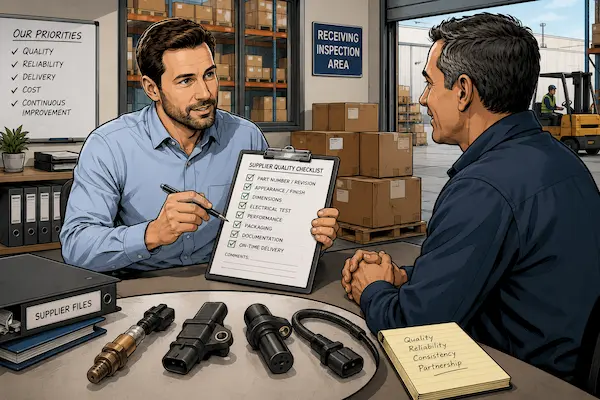
When I talk to new clients, I often find their supplier conversations are centered on two things: price and delivery date. This is a huge red flag. A supplier who only wants to talk about price is a supplier who is likely cutting corners elsewhere3. To break this cycle, you need to change the conversation. You need to start asking process-oriented questions that reveal the true quality of a potential partner. These questions move beyond a simple certification and probe the reality of their day-to-day operations.
Beyond the Price Tag: Process-Oriented Questions
A supplier's true value isn't on the invoice; it's in their processes. In our factory, our processes are everything. They are what allow us to deliver consistent quality. You need to find a partner who thinks the same way. Start by asking questions that test their operational discipline.
Understanding Your Supplier's Real Capabilities
A certificate on the wall is nice, but a process in action is what protects your business. Dig deeper to see if their claims match their reality.
| Question Category | Example Question to Ask | Why It Matters (Your Business Risk) |
|---|---|---|
| Quality System | "What is your documented process for handling an out-of-spec batch?" | Avoids receiving entire batches of faulty parts, reducing recall risk and protecting your inventory investment. |
| Material Traceability | "Can you provide traceability data for the raw materials in this MAP sensor?" | Ensures consistency and prevents failures from cheap, substandard materials that can degrade under engine conditions. |
| Inspection Protocol | "How does your IATF 16949 certification4 translate into your specific pre-shipment inspection protocols for this part?" | Verifies that their certification is actively implemented, not just a piece of paper. It confirms they are actively catching potential defects before they reach you. |
A supplier who can't answer these questions confidently is a significant risk. A partner who can provide detailed answers is demonstrating their commitment to quality, not just their desire to make a sale.
Is your purchasing framework based on risk or just price?
Your purchasing department is praised for securing the lowest unit price. Yet, this focus ignores the hidden costs of returns, warranty claims, and the slow erosion of customer trust in your brand.
Adopt a risk-based framework that evaluates the total cost of ownership5, not just the invoice price. A cheap sensor from a supplier with weak quality control is a massive financial liability waiting to happen6, threatening your profitability and brand reputation.
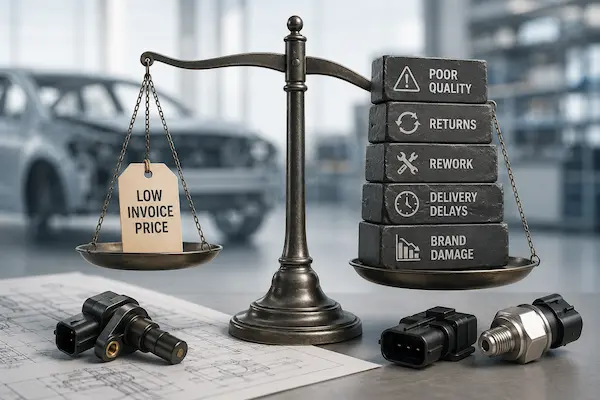
The most successful aftermarket brands I work with don't chase the absolute lowest price. They've learned from experience that the cheapest part often ends up being the most expensive. They have shifted from a simple price-based procurement model to a risk-based selection framework. This approach acknowledges that not all suppliers are created equal, and the biggest risks to your business aren't on the supplier's price list. It's a fundamental change in mindset from buying a commodity to building a strategic partnership.
Building a Supplier Risk Matrix
A simple way to start is by creating a risk matrix. This helps you visualize and compare potential suppliers on factors that actually impact your bottom line. It forces you to look beyond the unit cost.
| Supplier Attribute | Low-Risk Partner | High-Risk Vendor |
|---|---|---|
| Quality System | IATF 16949 Certified, 100% pre-shipment inspection documented. | No clear certification, vague or no inspection process. |
| Engineering Support | Full OEM/ODM capabilities, provides technical data and design support. | "As-is" products only, no engineering collaboration or support. |
| Logistical Reliability | Clear packaging standards, proven methods to prevent shipping damage. | Inconsistent packaging, a history of damaged goods on arrival. |
| Price Point | Competitive and stable, focused on value. | Rock-bottom prices, often fluctuating. |
Total Cost of Ownership vs. Unit Price
When you plot your suppliers on this matrix, a clear picture emerges. The high-risk vendor might offer a sensor that is $0.20 cheaper. But when you factor in a 5% return rate, the cost of processing warranties, paying for return shipping, and the staff time spent dealing with unhappy customers, that $0.20 savings vanishes. I've seen cases where the Total Cost of Ownership (TCO) for a "cheap" sensor is three to four times the initial purchase price7. A low-risk partner understands this. They invest in quality to help you lower your TCO, which is the true measure of a successful purchasing decision.
Do you know how a sensor's materials affect your business's reputation?
You might see a sensor as a simple "black box." It either works or it doesn't. This view makes you vulnerable to suppliers using cheaper materials that are destined to fail prematurely.
The choice of plastic for a housing or the grade of metal for a contact point directly impacts a sensor's lifespan8. A supplier using a cheaper material might save a few cents, but it can cause widespread failures that severely damage your brand's reputation.
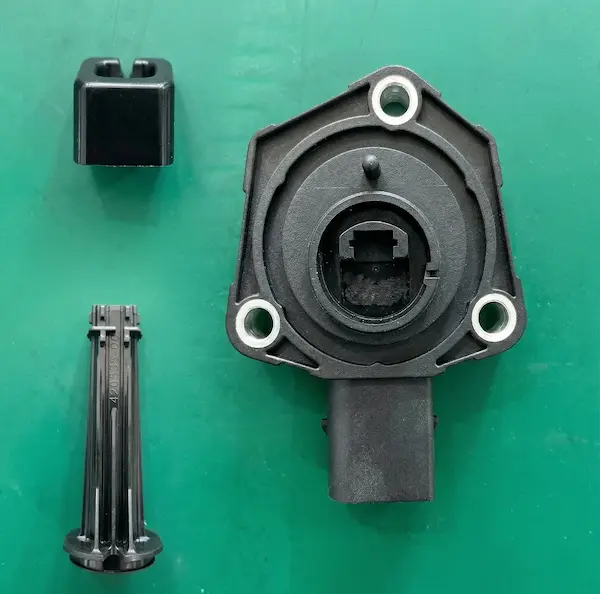
Technical details matter. They are not just for engineers; they are critical business risk factors. As a manufacturer, I spend a huge amount of my time focused on materials and processes, because I know that's where quality is truly built. A small, seemingly insignificant choice in material can be the difference between a part that lasts for years and one that fails in months, leading to a flood of returns for your business. The link between a technical detail and your brand's reputation is direct and unbreakable.
The Hidden Risk in a Plastic Housing
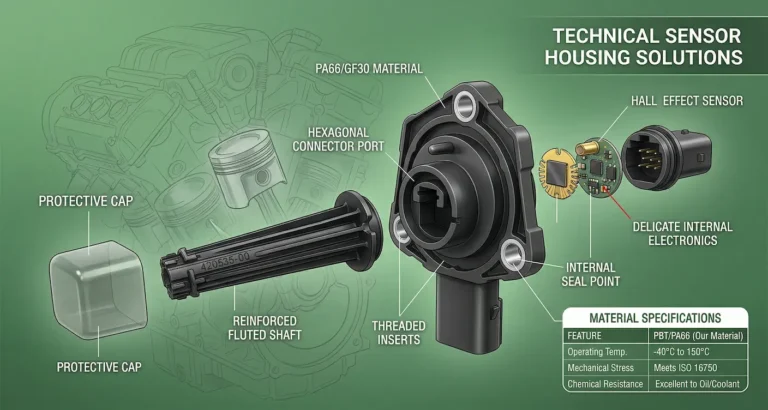
Let's take a common MAP sensor. It lives in the harsh environment of an engine bay, subject to extreme heat cycles, vibration, and chemical exposure. We manufacture our housings using high-grade, glass-filled PBT or PA66 plastic. It costs more. A high-risk supplier might use a basic, non-reinforced PP plastic to lower their price. It looks the same on the outside. But after a few thousand miles of engine heat cycles, that cheaper plastic becomes brittle and cracks9. Moisture gets in, the electronics fail, and the vehicle gets a check engine light.
From Technical Detail to Brand Damage
This single material choice has a cascading business impact. The table below shows how these technical decisions directly translate into business risks for you, the distributor.
| Component | Standard Material (Low-Risk Partner) | Substandard Material (High-Risk Vendor) | Business Impact of High-Risk Choice |
|---|---|---|---|
| Sensor Housing | Glass-filled PBT/PA66 Plastic | Basic PP Plastic | Cracking from engine heat, leading to moisture ingress and widespread premature failures. |
| Sensing Chip | Verified MEMS chip10 from a reputable source | Low-grade, unverified chip | Inaccurate readings, causing poor engine performance and frequent check engine lights for your customers. |
| Internal Wiring | Ultrasonic or resistance welding11 | Simple, low-temperature soldering | Connections break from normal engine vibration, causing intermittent failures that are frustrating and costly to diagnose. |
The supplier who uses the cheap solder saves a fraction of a cent. You, however, are left with a product that damages your reputation for reliability. That is why a true partner is transparent about their materials and processes. They understand that their success is tied to your brand's success in the market.
Conclusion
Stop asking why your sensors fail. Start asking if your supplier is a true partner. Adopting a better purchasing process is the only sustainable way to lower your return rate.
"[PDF] Management Strategies and Processes for Improving Product Returns", https://scholarworks.waldenu.edu/cgi/viewcontent.cgi?article=19065&context=dissertations. ↩
"Influence of Supplier Relationship Management on Product Quality", https://iprjb.org/journals/IJSCM/article/view/3118?srsltid=AfmBOoos-nUNNdvZGgdqapLtgtjRwTmJ6gHO61uDfD9KhjAJsTI78Gch. ↩
"Low price doesn't always mean low quality, but it could ... - The Source", https://source.washu.edu/2006/06/low-price-doesnt-always-mean-low-quality-but-it-could-mean-a-challenge-to-highend-products/. ↩
"IATF 16949 - Wikipedia", https://en.wikipedia.org/wiki/IATF_16949. ↩
"Procurement 101: Total Cost of Ownership (TCO) - CADDi", https://us.caddi.com/resources/insights/total-cost-ownership.pports: The definition and components of Total Cost of Ownership (TCO) in a business context. ↩
"What is COPQ (Cost of Poor Quality)? - SixSigma.us", https://www.6sigma.us/process-improvement/copq-cost-of-poor-quality/. ↩
"Price–performance ratio - Wikipedia", https://en.wikipedia.org/wiki/Price%E2%80%93performance_ratio. ↩
"Effect of Thermal and Vibration Changes on Automated External ...", https://pmc.ncbi.nlm.nih.gov/articles/PMC12364430/. ↩
"Molecular Pathways for Polymer Degradation during Conventional ...", https://pmc.ncbi.nlm.nih.gov/articles/PMC10004996/. ↩
"MEMS - Wikipedia", https://en.wikipedia.org/wiki/MEMS. ↩
"Impact of Ultrasonic Welding Parameters on Weldability and ... - PMC", https://pmc.ncbi.nlm.nih.gov/articles/PMC11509339/. ↩